

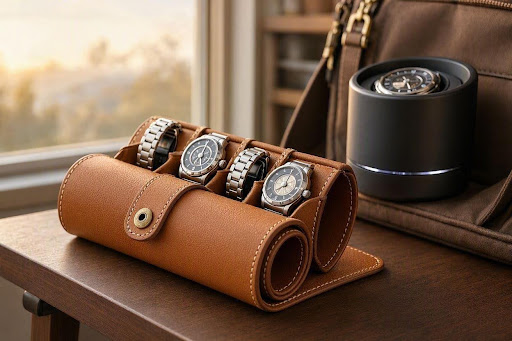
If you’ve recently added an automatic watch to your collection, or you’re finally getting serious about protecting the pieces you already own, you’ve probably run into the same question everyone does eventually: do you need a watch winder, a watch roll, or both?
It’s a fair question, and the answer isn’t the same for everyone. A single-watch owner has completely different needs from someone rotating through six or seven pieces a month. The good news is that once you understand what each item actually does, the decision becomes much simpler.
This guide walks through exactly what a watch winder and a watch roll are for, how they differ, and how to figure out which one (or both) belongs on your dresser.
What Is a Watch Winder and Why Do Automatic Watches Need One?
An automatic watch keeps time using the natural motion of your wrist. A small rotor inside the movement spins as you move, and that motion winds the mainspring, which powers the watch. The moment you take the watch off and set it down, that motion stops, and so does the winding.
Left alone for a day or two, most automatic watches will simply run down and stop. That’s not damaging on its own, but it does mean resetting the time and date every time you want to wear it again, which gets tedious fast, especially on watches with complicated date mechanisms or perpetual calendars.
A watch winder solves this by gently rotating the watch when it’s not on your wrist, mimicking the motion of walking. This keeps the mainspring wound and the watch running continuously, so it’s always ready to wear and never needs re-setting.
Watch winders are especially useful for:
- Watches with a perpetual calendar, which can be genuinely painful to reset correctly
- Pieces you wear only occasionally but want ready at all times
- High-end automatics where consistent lubrication distribution actually benefits from regular, gentle motion
- Anyone rotating through multiple watches and tired of resetting time and date each time
If you’re deciding between winder styles or want to see how one performs with a specific movement, it’s worth checking a detailed breakdown before buying, since not every winder suits every watch. The Aevitas guide on choosing the right winder for a Breitling movement is a genuinely useful example of how much variation there is between brands and calibers, and you can read more here before settling on a specific model.
What Is a Watch Roll and What Problem Does It Actually Solve?
A watch roll is a soft, padded case, usually made from leather, designed to hold and protect multiple watches during storage or travel. Unlike a winder, a roll doesn’t power or maintain the watch in any way. It simply protects it.
Each watch sits in its own individually cushioned slot, which prevents the crystal, case, and bracelet from scratching against other watches or hard surfaces. Good leather watch rolls also protect against dust, moisture, and the kind of accidental knocks that happen when watches are just tossed in a drawer together.
Watch rolls tend to matter most for:
- Travelers who want to bring more than one watch without risking damage
- Anyone storing watches in a drawer rather than a dedicated safe or winder box
- Collectors who want a compact, protective way to organize several pieces
- Watches that don’t need continuous winding, such as manual watches or automatics you’re happy to reset occasionally
A well-made leather roll genuinely earns its price. Cheap synthetic versions tend to have thin padding and stitching that fails within a year, while a properly constructed roll will outlast most watches you put in it.
Watch Winder vs Watch Roll: The Key Differences
| Watch Winder | Watch Roll | |
| Main purpose | Keeps automatic watches running | Protects and organizes watches |
| Powers the watch | Yes | No |
| Best for | Complicated calendars, frequent rotation | Travel, storage, multiple watches |
| Portable | Rarely (needs power) | Yes |
| Typical material | Wood, leather, motorized mechanism | Leather, suede lining |
The short version: a winder keeps time, a roll keeps watches safe. They solve two entirely different problems, which is why plenty of serious collectors eventually own both.
Do You Actually Need a Watch Winder?
Not every automatic watch owner needs one, and it’s worth being honest about that before spending money.
You’ll likely benefit from a winder if:
- You own a watch with a perpetual calendar or moon phase complication
- You have more watches than you wear regularly, and hate resetting them
- You want to keep a specific piece “always ready” for unpredictable occasions
You probably don’t need one if:
- You wear the same one or two watches daily
- Your watches have simple date functions that take seconds to correct
- You’re comfortable manually winding or resetting occasionally
There’s no harm in manually resetting a watch. It’s a myth that automatic movements need constant motion to stay healthy. What a winder actually buys you is convenience, not mechanical necessity.
Do You Need a Watch Roll Instead (or As Well)?
If your priority is protecting your collection rather than keeping every piece wound, a roll is the more practical starting point, especially if you travel or store more than two or three watches.
A roll is also the better first purchase for newer collectors. It’s less expensive, doesn’t require power, and solves the more immediate problem most people actually have: watches getting scratched or tangled together in a drawer.
Many collectors follow a simple pattern: a winder for the one or two watches worn in rotation that benefit from staying wound, and a roll for everything else, plus travel.
Storing Watches Long-Term: What Actually Matters
Whether you use a winder, a roll, or both, a few habits protect your watches regardless of which storage method you choose:
Keep watches away from direct sunlight and heat. UV exposure fades dials and can degrade leather straps over time.
Avoid magnetic fields. Phones, speakers, and laptop lids can throw off the accuracy of a mechanical movement.
Store at stable humidity. Extreme dryness or dampness affects both movements and leather components.
Service mechanical watches periodically. No storage method replaces a proper service. Most manufacturers recommend a full service every few years regardless of how the watch is stored.
For deeper technical detail on how automatic movements actually function mechanically, the Wikipedia entry on automatic watches is a solid, well-sourced starting point if you want to understand the mainspring and rotor system in more depth.
Building a Collection Around the Right Accessories
As a collection grows past two or three pieces, most people find they need a mix of solutions rather than a single answer. A winder for the watches worn least often but relied on for accuracy, a roll for travel and safe storage, and eventually a proper watch box or safe once the collection reaches a certain size.
If you’re just getting started, browsing a dedicated collection of accessories built specifically for these needs saves a lot of trial and error compared to buying generic storage online. The Aevitas UK store carries a curated range built around exactly this kind of collector, from winders through to rolls and cases, so you’re not stuck cross-referencing compatibility yourself.
Final Thoughts
There’s no single right answer between a watch winder and a watch roll, because they’re not actually competing products. A winder keeps automatic watches running and ready. A roll protects and organizes them. Most collectors eventually want both, but which one to buy first depends entirely on what’s actually causing you friction right now.
If resetting complicated date functions is the annoyance, start with a winder. If scratched cases and tangled straps in a drawer are the problem, a roll solves that immediately and costs a fraction as much. Either way, buying based on your actual habits, rather than what looks impressive on a shelf, will save you money and get more use out of whatever you choose.
FAQs
Do automatic watches stop if not worn? Yes. Without wrist motion or a winder, the mainspring gradually unwinds and the watch stops, typically within 24 to 48 hours depending on the movement’s power reserve.
Is it bad to leave an automatic watch unworn for months? Not damaging, but the lubricants inside can settle unevenly over very long periods of inactivity. Occasional winding or wearing every few weeks is generally recommended even for watches you don’t wear regularly.
Can I put a manual (hand-wound) watch in a winder? No. Winders are designed for automatic movements with a rotor. A manual watch has no rotor and must be wound by hand regardless of how it’s stored.
How many watches should a watch roll hold? Rolls typically come in 2, 3, 5, or more slots. Buy based on how many watches you actually travel with or rotate regularly, rather than your full collection size, since overstuffing a roll defeats its protective purpose.
Do cheaper watch winders damage watches? Poorly made winders with inconsistent or overly aggressive rotation settings can, over time, cause unnecessary wear. Choosing a winder with adjustable turns-per-day (TPD) and direction settings matched to your specific watch’s movement is worth the extra cost.