

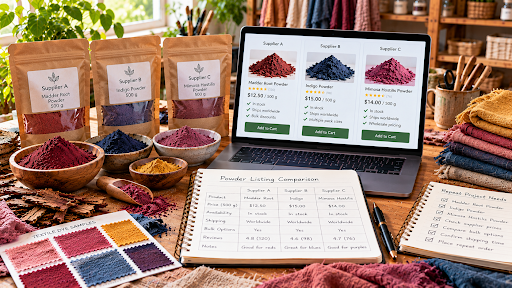
For repeat textile projects using Mimosa root bark powder, product records help a studio compare new listings with the specifications of previously evaluated materials. Whether the workshop creates handmade scarves, fabric samples, decorative textiles, or naturally colored craft items, reliable material records can make future purchasing decisions easier.
Botanical powder listings often look similar at first glance. However, differences in plant identification, processing methods, package weights, labeling, and supplier documentation can make one product more suitable for a particular project than another.
For repeat textile work, buyers should look beyond promotional descriptions and focus on information that can be recorded, checked, and compared.
This guide explains how to evaluate botanical powder listings, compare supplier details, inspect product labels, and establish a practical purchasing process for recurring textile projects.
Why Repeat Textile Projects Require More Careful Supplier Research
A single craft experiment may involve only a small quantity of material. Repeated production, however, requires more structured planning.
When a workshop prepares similar textile items every month, material purchases must align with production schedules, storage capacity, and available budgets.
An incomplete product description can make repeat ordering difficult. For example, a previous purchase may have been finely milled, while a new listing under the same botanical name offers shredded material.
Although both products may originate from the same plant, their handling characteristics can differ.
Identify the Specifications That Matter Most
Before comparing suppliers, document the requirements of the project:
- Scientific botanical name.
- Plant part required.
- Preferred processing format.
- Package weight.
- Expected monthly consumption.
- Available storage space.
- Delivery destination.
- Purchasing budget.
These details create a consistent basis for comparing products.
Read the Botanical Name Before the Product Description
Scientific identification is an important starting point when evaluating plant-based craft supplies.
Some botanical species are known by multiple common names or historical scientific synonyms.
For example, Mimosa tenuiflora is also commonly referenced as Mimosa hostilis.
The abbreviation MHRB generally refers to Mimosa hostilis root bark.
However, a botanical name or abbreviation on a product listing does not independently verify the identity or quality of the contents.
Confirm the Plant Part
A complete listing should identify whether the material consists of root bark, stem bark, leaves, or another plant component.
These materials should not automatically be treated as interchangeable.
Check for Consistent Naming
If a supplier uses different names across its product pages, ask for clarification before ordering.
Maintaining one standardized botanical name in workshop records can help prevent confusion during future purchases.
Understanding Powder Texture and Processing Differences
The term “botanical powder” can describe materials with different particle sizes and preparation characteristics.
For repeat textile projects, the processing format should be recorded alongside the botanical name.
Fine-Milled Botanical Powder
Fine powder consists of dried plant material ground into relatively small particles.
It may be convenient to weigh and divide into portions for controlled craft experiments.
However, fine particles can become airborne during handling and may require additional filtration in some liquid preparations.
Fine milling does not automatically guarantee greater purity, stronger color, or improved textile performance.
Coarse Botanical Powder
Coarse powder contains larger particles and may retain more visible plant texture.
Because milling standards vary between suppliers, buyers should request clarification when particle size matters.
Shredded Root Bark
Shredded bark consists of larger dried plant fragments.
It may be useful for botanical demonstrations, educational craft projects, and applications where recognizable plant material is preferred.
Root Bark Chips
Chips are larger botanical pieces that may require different handling or preparation arrangements.
When comparing listings, buyers should record each format separately rather than assuming that all products from the same species are equivalent.
Reviewing One-Kilogram Powder Listings for Regular Craft Work
A one-kilogram package can be worth evaluating when a workshop has already documented its material requirements and expects to use the same botanical ingredient repeatedly.
For example, buyers comparing the 1kg MHRB powder price should examine the selected product variation rather than relying only on the starting price displayed on the page.
The supplier currently advertises a 1kg product with chips, shredded, and powder selections. Its listing shows a starting price of $162 for the chips variation.
The price of the powder variation should be confirmed separately before ordering.
Check More Than the Package Weight
When reviewing a 1kg listing, confirm:
- The scientific botanical name.
- The plant part supplied.
- The selected processing format.
- The net package weight.
- The current price for that variation.
- The available batch information.
- The packaging and storage recommendations.
- The shipping conditions.
These checks can help avoid confusion when ordering materials for recurring projects.
Evaluating Label Information for Better Material Traceability
Product labels can provide useful information for organizing workshop inventory.
For repeat projects, traceability helps connect material purchases with specific textile batches.
Botanical Identification
The label should identify the botanical material as precisely as possible.
Processing Format
Powder, shredded bark, and chips should be clearly distinguished.
Net Weight
The stated quantity should refer to the botanical material rather than the combined weight of the shipping package.
Batch or Lot Number
Batch identifiers, when available, can help connect products with supplier documentation.
Storage Instructions
Appropriate storage information can help workshops maintain organized supplies.
The referenced supplier states that its 1kg powder is packaged in a resealable, light-blocking pouch and that batch numbers are printed on packages. These are supplier-published statements, so buyers should confirm the details of the product they receive.
Comparing Product Categories Before Reordering
A product category can provide a broader view of the available quantities and formats.
For example, textile makers researching mimosa hostilis root bark powder can compare individual product listings within the supplier’s catalog.
The category currently displays several package sizes, including 100g, 500g, 1kg, 2kg, 5kg, and 10kg.
However, a category page may display starting prices rather than the final cost of a specific processing format.
Buyers should review the individual product page and confirm the selected variation before placing an order.
Build a Comparison Table
| Product Detail | What to Record |
| Botanical Name | Scientific species |
| Plant Part | Root bark or another component |
| Processing Format | Fine powder, coarse powder, shredded, or chips |
| Package Weight | Net quantity |
| Listed Price | Price for the selected variation |
| Supplier | Seller name |
| Batch Information | Available identification records |
| Shipping Conditions | Confirmed delivery terms |
| Last Reviewed | Date of comparison |
This approach makes repeat purchasing more organized.
Comparing Unit Prices Across Different Package Sizes
A larger package may offer a lower cost per kilogram, but the lowest unit price is not always the best purchasing decision.
The basic calculation is:
Cost per kilogram = Package price ÷ Package weight in kilograms
Consider the following hypothetical comparison:
| Package Weight | Example Price | Cost per Kilogram |
| 250g | $40 | $160 |
| 500g | $75 | $150 |
| 1kg | $140 | $140 |
| 2kg | $260 | $130 |
| 5kg | $600 | $120 |
These figures are illustrative examples and do not represent verified prices from the linked supplier.
A workshop should also consider shipping charges, taxes, storage requirements, and expected material consumption.
Buying more material than necessary can increase costs even when the advertised unit price is lower.
Matching Powder Purchases to Textile Production Schedules
Purchasing quantities should reflect actual project requirements.
Suppose a studio plans to prepare 36 cotton scarves, each weighing approximately 150 grams.
The total fabric weight would be:
36 × 150g = 5,400g
This equals 5.4kg of fabric.
However, fabric weight alone does not establish how much botanical powder is required.
Natural botanical materials can vary in composition depending on species, origin, processing, and storage conditions.
Textile fibers and preparation methods may also influence outcomes.
For this reason, workshops should use documented small-scale testing to estimate material requirements rather than assuming a universal botanical-to-fabric ratio.
Maintain a Project Material Log
Useful records include:
- Project name and date.
- Textile type and fabric weight.
- Botanical material.
- Supplier and batch information.
- Processing format.
- Quantity used.
- Preparation notes.
- Observed results.
These records can help inform future purchasing decisions without guaranteeing identical outcomes.
Checking Supplier Documentation and Quality Claims
Supplier transparency is an important part of comparing botanical materials.
Product descriptions may contain claims about purity, laboratory testing, sourcing, or sustainability.
Such statements should be treated as supplier-provided information unless independently supported by appropriate documentation.
Ask About Batch Records
Batch identification can help workshops maintain traceability.
Review Available Testing Information
If laboratory testing is advertised, buyers can request relevant certificates or reports and examine what was actually tested.
Confirm Processing Details
When particle size matters, ask whether the supplier provides measurable milling specifications.
Review Customer Support Policies
Accessible contact information and clear purchasing policies can help buyers resolve product questions.
Reviewing Shipping Conditions for Repeat Orders
Shipping policies can affect the total cost and reliability of workshop purchasing.
The linked supplier advertises free U.S. shipping and international shipping options. Its category page also states that it serves 49 U.S. states.
These are published supplier claims rather than independently verified delivery guarantees.
Before placing an order, confirm:
- Whether the destination is eligible.
- Whether shipping charges apply.
- Estimated processing times.
- Available tracking services.
- Packaging arrangements.
- Return and replacement procedures.
- Customs or import requirements.
- Applicable local regulations.
Published delivery estimates should not be treated as guaranteed arrival dates.
For international orders, buyers should verify whether the selected botanical material can legally be imported into the destination.
Inspecting Botanical Materials After Delivery
Supplier evaluation should continue when an order arrives.
Compare the delivered product with the original listing and order confirmation.
Check whether:
- The correct botanical material was supplied.
- The processing format matches the order.
- The package weight is consistent with the purchase.
- The packaging shows visible damage.
- The label contains the expected information.
- Batch details match any available documentation.
If the product differs from the order, contact the supplier before using it.
Storing Powdered Craft Materials for Future Projects
Botanical powders should be stored in suitable containers that protect them from excessive moisture, contamination, and unsuitable environmental conditions.
Each container should be labeled with the botanical name, processing format, purchase date, and batch number when available.
Fine powders can create airborne dust, so appropriate ventilation and protective equipment may be necessary.
Keep botanical craft materials separate from food preparation areas.
If textile projects involve mordants or other processing chemicals, follow the relevant safety instructions and disposal requirements.
Natural origin does not automatically mean a material is harmless.
Frequently Asked Questions About Comparing Botanical Powder Listings
What should I check before purchasing botanical powder for textile projects?
Review the scientific name, plant part, processing format, package weight, supplier documentation, and shipping conditions.
Is a 1kg package suitable for repeat textile projects?
A one-kilogram package may be practical when material requirements are established, but suitability depends on actual consumption and storage capacity.
Are fine powder and shredded root bark interchangeable?
Not necessarily. They have different particle sizes and may require different handling or preparation methods.
How can I compare powder prices across suppliers?
Calculate the cost per kilogram and include shipping, taxes, and other purchasing expenses.
Can botanical powders produce identical dye results in every project?
No specific result can be guaranteed. Botanical composition, textile fibers, and preparation conditions may influence the outcome.
Why should textile workshops record supplier batch numbers?
Batch records can support traceability, help organize inventory, and make it easier to investigate differences between purchases.
Conclusion: Make Repeat Purchasing More Reliable
Comparing powder listings for repeat textile projects requires attention to botanical identification, processing formats, product labels, and supplier documentation.
For workshops that regularly purchase plant-based craft materials, maintaining accurate records can reduce confusion and support more organized purchasing.
Package sizes should be selected according to documented material consumption rather than advertised savings alone.
By reviewing product specifications, checking supplier claims, comparing total purchasing costs, and recording material details after delivery, textile makers can make more informed decisions.
A structured supplier comparison process supports better inventory management, realistic project planning, and more efficient textile workshop operations.