

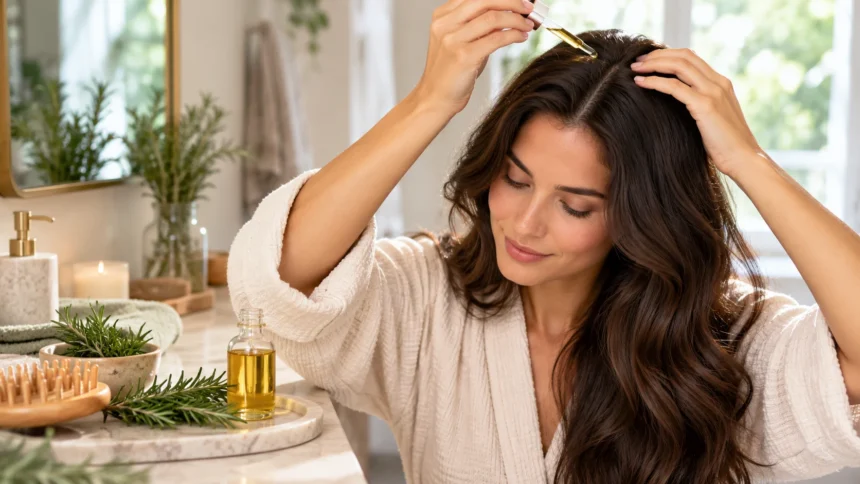
Rosemary oil has become a popular ingredient in natural hair care routines because of its aromatic properties and potential benefits for scalp health. Extracted from the rosemary plant, this essential oil contains naturally occurring compounds that have attracted interest in cosmetic and scientific research. Many people are curious about using rosemary oil for hair care, particularly when exploring botanical alternatives to conventional products.
Understanding how to use rosemary oil for hair involves learning about its possible benefits, appropriate formulations, and important safety precautions. Although early research suggests potential benefits for certain types of hair loss, scientific evidence remains limited. This guide explains what rosemary oil does, how it is commonly incorporated into hair products, and what to consider before introducing it into a regular hair care routine.
What Is Rosemary Oil for Hair?
Rosemary oil is an aromatic essential oil extracted from the leaves and flowering portions of the rosemary plant, scientifically known as Salvia rosmarinus. This Mediterranean herb has traditionally been used in cooking, fragrances, and personal care products. Its essential oil contains concentrated plant compounds that produce a distinctive herbal scent and contribute to its popularity in cosmetic formulations.
In hair care, rosemary oil appears in scalp treatments, shampoos, conditioners, and specially formulated hair oils. Manufacturers may combine it with other ingredients to create products intended for cleansing, conditioning, or scalp massage. However, concentrated rosemary essential oil differs significantly from ready-to-use hair products because its strength and potential to irritate skin are considerably greater.
Rosemary-infused oil is another product sometimes confused with rosemary essential oil. An infused preparation typically contains rosemary plant material steeped in a carrier oil, while essential oil is a concentrated aromatic extract. Understanding this distinction matters because different preparations have different ingredients, strengths, and safety considerations when used in personal care products.
Potential Benefits of Rosemary Oil for Hair
Rosemary oil contains compounds that have been investigated for antioxidant and other biological properties. These characteristics have encouraged researchers to explore whether certain rosemary preparations might support scalp health. However, results from laboratory studies do not automatically demonstrate that applying rosemary oil improves hair growth or treats scalp conditions in everyday situations.
Some commercially formulated rosemary products may help condition the scalp or make a hair care routine more enjoyable through their fragrance and texture. The actual effects depend on the entire formulation rather than rosemary oil alone. Conditioning oils can also improve the appearance of dry hair by reducing friction and adding surface smoothness, although these effects are not unique to rosemary.
One important consideration is that rosemary oil should not be presented as a guaranteed solution for hair loss, dandruff, or scalp irritation. Each of these concerns can have several underlying causes that require different approaches. Botanical hair products may complement an ordinary grooming routine, but they should not replace appropriate medical assessment when symptoms are persistent or unexplained.
Does Rosemary Oil Really Help Hair Growth?
Research into rosemary oil and hair growth remains limited, although one small clinical trial has attracted considerable attention. The study compared a specific rosemary oil lotion with a two-percent minoxidil treatment among adults experiencing androgenetic alopecia. After six months, researchers observed increased hair counts in both groups, suggesting that further investigation could be worthwhile.
However, the study did not establish that rosemary oil works for every type of hair loss or that it performs equally well for everyone. The trial was relatively small, and it did not include an untreated placebo group. Additional high-quality research is needed to determine effectiveness, ideal formulations, long-term safety, and whether findings apply to broader populations.
Hair growth is influenced by genetics, age, hormones, nutrition, health conditions, and the natural hair cycle. A single cosmetic ingredient cannot address every cause of hair shedding or changes in hair density. Anyone experiencing sudden, patchy, or persistent hair loss should seek professional guidance rather than depending on an essential oil to solve the problem.
Understanding How Rosemary Oil Is Used in Hair Products
Rosemary oil is commonly included in commercially prepared scalp oils, shampoos, and conditioners. Each product type serves a different purpose, with shampoos designed for cleansing and conditioners intended to improve manageability. Scalp serums and hair oils may remain on the skin longer, making ingredient strength and formulation particularly important for people with sensitive scalps.
Ready-to-use rosemary hair products are generally easier to evaluate than homemade essential oil mixtures because they include manufacturer instructions and ingredient information. Product labels may explain the intended application area, frequency, and whether rinsing is necessary. Following those directions helps reduce the chance of unnecessary exposure, especially when multiple fragranced products are already part of a routine.
Concentrated rosemary essential oil should not be applied directly to the scalp because it may cause irritation or allergic reactions. Professional safety guidance emphasizes appropriate dilution, and specific rosemary essential oil preparations are not recommended for people under 18 because of insufficient safety data. For younger users, gentle standard hair care is a safer starting point.
Why Rosemary Oil Should Be Diluted
Essential oils are highly concentrated extracts, meaning relatively small amounts can contain substantial quantities of aromatic compounds. Applying an undiluted essential oil directly to the skin can trigger redness, itching, burning sensations, or allergic contact dermatitis. Rosemary oil is not exempt from these risks simply because it comes from a familiar culinary herb.
Carrier oils such as jojoba, coconut, and certain other cosmetic oils are commonly used in professionally formulated products to reduce the concentration of essential oils. However, the appropriate formulation depends on the intended use, age group, and individual skin tolerance. Adding an arbitrary quantity of essential oil to another product does not guarantee that the resulting mixture is safe.
A labeled, age-appropriate product provides a clearer starting point than guessing at a homemade mixture. Before using any unfamiliar cosmetic, review its instructions, ingredients, and safety warnings. People with eczema, sensitive skin, fragrance allergies, or existing scalp irritation should be particularly cautious and seek professional advice when necessary.
Rosemary Oil and Scalp Massage
Scalp massage is often discussed alongside rosemary oil because many hair products are applied through gentle contact with the scalp. Massage can feel relaxing and may help distribute certain conditioning products across the skin. However, this pleasant sensation should not be confused with proof that massage or rosemary oil can reliably stimulate new hair growth.
The scalp contains delicate skin, hair follicles, and natural protective oils that help maintain a healthy surface environment. Aggressive rubbing, repeated scratching, or excessive friction can irritate the scalp and place unnecessary stress on hair strands. Gentle grooming practices are generally preferable, particularly when the skin is dry, inflamed, or sensitive.
People who enjoy scalp massage do not need rosemary essential oil to make the experience comfortable. A gentle touch during ordinary hair washing may be sufficient for routine cleansing and relaxation. If a scalp treatment causes discomfort, redness, or itching, discontinue the product instead of attempting to increase application time or frequency.
Can Rosemary Oil Be Added to Shampoo?
Rosemary oil is already included in some shampoos and scalp-cleansing products sold commercially. These formulations combine cleansing ingredients with fragrances, conditioning agents, and other components designed to function together. The concentration of each ingredient affects how the product behaves during washing and how suitable it may be for different scalp types.
Adding concentrated essential oil directly to a shampoo bottle can alter the product’s intended formulation and potentially distribute the oil unevenly. This may increase the likelihood of irritation, especially if concentrated droplets come into direct contact with the scalp. Choosing a properly formulated rosemary shampoo is generally more predictable than modifying an existing cosmetic product.
When evaluating a rosemary shampoo, consider your scalp’s needs rather than assuming the botanical ingredient guarantees better results. People with dry hair may prefer conditioning formulas, while those with an oily scalp may need different cleansing properties. A product’s overall ingredient combination, suitability, and tolerability matter more than one ingredient featured prominently on its packaging.
Rosemary Oil for Dry and Frizzy Hair
Dry and frizzy hair often benefits from conditioning products that reduce surface friction and improve moisture retention. Rosemary oil itself is not a proven moisturizing treatment, but it may appear in formulas containing emollients that help smooth the hair. These supporting ingredients often contribute more directly to softness and manageability than the rosemary extract.
Hair dryness can develop because of environmental conditions, frequent heat styling, chemical processing, or natural differences in hair texture. A gentle shampoo and suitable conditioner can help maintain comfortable, manageable hair without requiring a complicated routine. Limiting unnecessary heat exposure and handling wet hair carefully may also help reduce avoidable breakage.
People considering rosemary-containing products for dry hair should examine the full formulation and avoid products that cause scalp irritation. Strong fragrances and concentrated essential oils are not necessary for effective conditioning. Hair care products should support comfort and manageable styling rather than promising dramatic changes to a person’s natural hair type or appearance.
Rosemary Oil for Dandruff and an Itchy Scalp
Dandruff is a common scalp condition associated with flaking and sometimes itching or irritation. Although rosemary contains compounds studied for antimicrobial properties, there is insufficient clinical evidence to recommend rosemary essential oil as a reliable dandruff treatment. Laboratory activity against microorganisms does not necessarily mean a cosmetic product can control dandruff effectively.
Persistent dandruff may respond better to established scalp-care treatments designed for the underlying condition. Certain medicated shampoos contain ingredients that have been specifically studied for dandruff management. Choosing an appropriate treatment depends on symptom severity, scalp sensitivity, and other factors that a healthcare professional can help evaluate when necessary.
An itchy scalp should not automatically be treated with essential oils because fragranced products can sometimes make irritation worse. Redness, scaling, tenderness, or persistent discomfort may indicate an underlying skin condition. Avoid scratching excessively, discontinue products that cause reactions, and seek medical guidance if symptoms continue or interfere with everyday comfort.
How Often Should Rosemary Hair Products Be Used?
The appropriate frequency for rosemary-containing hair products depends on their ingredients, intended purpose, and manufacturer recommendations. A rinse-off shampoo may have different usage directions from a leave-on scalp serum. There is no scientifically established universal schedule proving that more frequent rosemary oil application produces better hair growth or healthier scalp conditions.
Overusing hair oils can create unwanted buildup, particularly when several styling products are applied together. Some people may notice greasy roots, discomfort, or difficulty removing residue during ordinary cleansing. Others may experience irritation from repeated exposure to fragranced ingredients, highlighting the importance of a routine that matches individual scalp needs.
The safest approach is to follow the instructions for an age-appropriate, commercially formulated product and pay attention to how the scalp responds. If itching, redness, or discomfort develops, stop using it. For children and teenagers, concentrated rosemary essential oil is not recommended without appropriate medical guidance because safety information for these age groups is insufficient.
Common Mistakes to Avoid With Rosemary Oil
One common mistake is assuming that natural ingredients cannot cause adverse reactions. Essential oils contain biologically active compounds that may irritate skin or trigger allergies in sensitive individuals. The word natural does not guarantee safety, particularly when an ingredient is highly concentrated or used on already irritated skin.
Another mistake is expecting rapid changes in hair growth after trying a botanical product. Hair naturally moves through growth, transition, and resting phases, making meaningful changes difficult to evaluate over short periods. Because research on rosemary oil remains limited, dramatic claims about immediate regrowth or guaranteed results should be treated cautiously.
Some people also combine multiple strong hair treatments without considering potential interactions or irritation. Using several fragranced products simultaneously can make it difficult to identify the cause of a scalp reaction. Keeping a simple routine and introducing only suitable products helps maintain comfort while avoiding unnecessary experimentation with concentrated botanical ingredients.
Rosemary Oil Compared With Other Hair Oils
Rosemary essential oil differs from familiar hair oils such as coconut, argan, and jojoba because it is primarily a concentrated aromatic extract. Coconut and argan oils are commonly used as conditioning ingredients, while jojoba oil is a liquid wax often included in skin and hair products. These materials serve different cosmetic purposes and should not be considered interchangeable.
Coconut oil has been studied for its ability to reduce protein loss from hair under certain conditions. Argan oil is frequently used in conditioning products that improve surface smoothness and shine. Rosemary oil has received attention primarily for its possible effects on hair growth, although clinical evidence remains much more limited than popular online claims sometimes suggest.
Choosing a hair oil should depend on the intended cosmetic purpose, hair characteristics, and scalp sensitivity. Someone interested in easier detangling may benefit from an ordinary conditioning product rather than an essential oil. Comparing complete formulations and realistic benefits is more useful than ranking individual botanical ingredients as universally superior for every person.
How to Choose a Rosemary Hair Care Product
A suitable rosemary hair product should have clear ingredient information, understandable usage instructions, and an intended purpose that matches your needs. Reputable manufacturers generally identify whether their product is a shampoo, conditioner, scalp serum, or cosmetic oil. This information helps consumers distinguish ordinary grooming products from concentrated essential oil preparations.
Look for transparent labeling and avoid products that promise instant regrowth, guaranteed hair restoration, or cures for medical scalp conditions. Such claims may exaggerate what current research can support. Product suitability also depends on fragrance sensitivity, accompanying ingredients, and whether the formulation has appropriate safety guidance for its intended users.
When purchasing hair care products for teenagers or children, age suitability deserves particular attention. Concentrated rosemary essential oil is not recommended for under-18 use in relevant herbal safety guidance because of insufficient data. Gentle, age-appropriate cleansing and conditioning products are preferable unless a qualified healthcare professional recommends a different approach for a specific concern.
Conclusion
Rosemary oil is a popular botanical ingredient found in shampoos, conditioners, scalp treatments, and other hair care products. Its distinctive fragrance and potential biological properties have encouraged scientific interest, particularly regarding certain types of hair loss. However, current evidence remains limited, and rosemary oil should not be considered a guaranteed treatment for hair growth or scalp conditions.
Understanding safe use is essential because concentrated essential oils can cause irritation, allergic reactions, and discomfort when applied incorrectly. Choosing suitable commercial formulations, checking product instructions, and avoiding unnecessary experimentation are sensible precautions. People under 18 should avoid concentrated rosemary essential oil unless advised otherwise by an appropriate healthcare professional.
Healthy hair care does not require a complicated collection of botanical ingredients or expensive products. Gentle cleansing, appropriate conditioning, careful styling, and attention to scalp comfort provide a practical foundation for everyday grooming. Anyone experiencing persistent itching, noticeable hair loss, or other concerning symptoms should seek professional advice rather than relying entirely on cosmetic remedies.
Frequently Asked Questions (FAQs)
Does Rosemary Oil Really Help Hair Growth?
One small clinical trial found encouraging results in adults with pattern hair loss after six months. However, the evidence remains limited, and larger studies are needed before rosemary oil can be considered a proven treatment.
Can I Apply Rosemary Essential Oil Directly to My Scalp?
Undiluted rosemary essential oil should not be applied directly because it can irritate skin or cause allergic reactions. Concentrated rosemary preparations are also not recommended for people under 18 because of limited safety data.
How Long Does Rosemary Oil Take to Work on Hair?
There is no guaranteed timeline. One small adult clinical trial reported changes after six months, but results cannot be generalized to everyone, and rosemary oil has not been proven effective for all causes of hair loss.
Can Rosemary Oil Help With Dandruff?
There is insufficient clinical evidence that rosemary oil reliably treats dandruff. Persistent flaking or itching may require a suitable medicated shampoo or professional assessment, especially when the scalp is inflamed or uncomfortable.
Is Rosemary Oil Suitable for Every Hair Type?
Rosemary-containing products may be formulated for different hair types, but suitability depends on the complete ingredient list and individual skin sensitivity. Concentrated essential oil requires extra caution and is not recommended for under-18 use.